How Will AI Affect Jobs in the UAE? What 2026 Data Shows
The UAE uses AI more than any other country, and that is already changing jobs in Dubai and Abu Dhabi. Here is what the 2026 data from Microsoft, PwC and MOHRE shows about which roles are at risk, which are growing, and how much more AI skills pay.
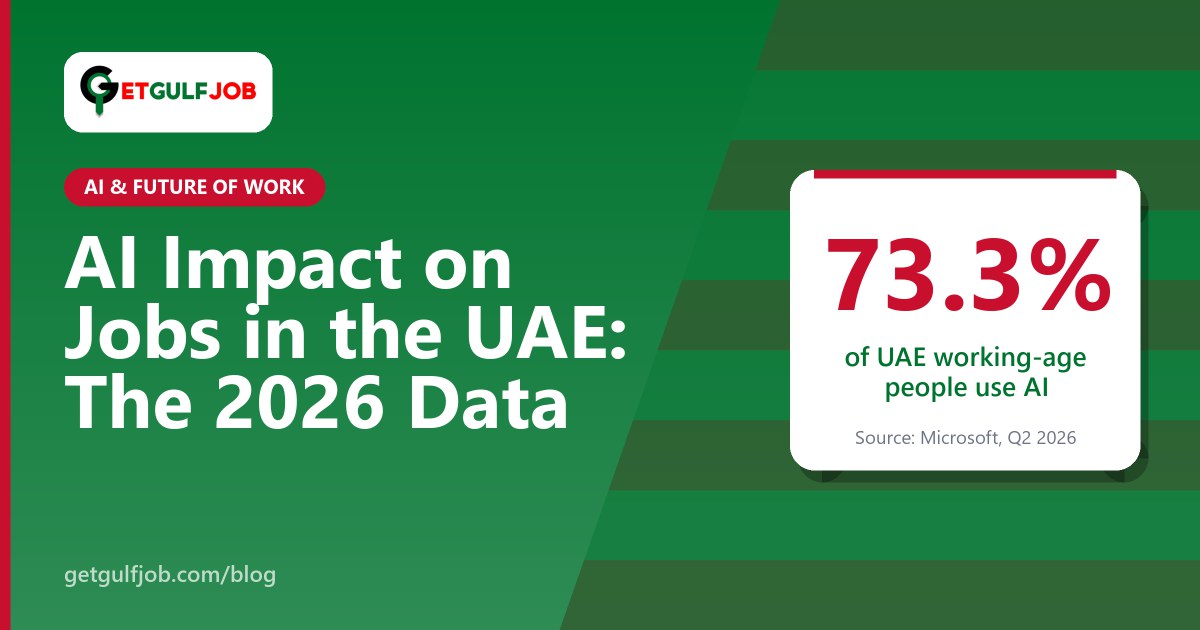
Table of contents
Last reviewed: 17 October 2026
Short answer: the AI impact on jobs in the UAE is bigger than almost anywhere else, because the UAE uses AI more than any other country. By mid-2026, 73.3% of the UAE's working-age population was using generative AI tools, the highest rate in the world (Microsoft AI Economy Institute). So far, AI is changing jobs more than removing them: the private sector workforce still grew 2.5% in the first quarter of 2026 (MOHRE). But routine office, admin and customer service work is shrinking, while people with AI skills earn up to 92% more in some industries (PwC).
Here's what this means if you live and work in Dubai, Abu Dhabi or anywhere in the Emirates.
Key takeaways
- 73.3% of the UAE's working-age population used generative AI in Q2 2026, ranking first in the world (Microsoft).
- The share of UAE job adverts asking for AI skills rose from 1% in 2021 to 3.2% in 2025 (PwC 2026 AI Jobs Barometer).
- AI skills earn a wage premium of up to 92% in financial services and 50% in technology, media and telecoms (PwC).
- The UAE's private sector workforce grew 2.5% in Q1 2026, so overall hiring is still rising (MOHRE).
- Free AI training is available to everyone through Dubai's One Million Prompters programme.
Is AI taking jobs in the UAE?
Not on a large scale. The UAE economy is growing, new companies keep opening, and MOHRE reported that the private sector workforce grew 2.5% in the first three months of 2026, with skilled jobs up 1.5%. That isn't what a market losing jobs to AI looks like.
What AI is doing is changing which jobs companies hire for. Employers in Dubai and Abu Dhabi are using AI chatbots for customer queries, AI tools for document processing, and AI systems for scheduling and reporting. When a company grows, it may now add fewer junior admin or call centre staff than it would have five years ago, and more people who can manage and improve those AI systems.
Why does the UAE use AI more than any other country?
Because the government has pushed it harder than almost any other. The UAE appointed the world's first Minister of State for Artificial Intelligence in 2017, published a National AI Strategy 2031, and has made AI part of government services, schools and business licensing. Microsoft's AI Economy Institute found that 70.1% of the working-age population used generative AI in the first quarter of 2026, rising to 73.3% in the second quarter, ahead of every other country, including Singapore in second place.
For job seekers, that means one thing: UAE employers increasingly assume you can use AI tools. It's becoming a basic skill, like email or Excel.
Which jobs in the UAE are most exposed to AI?
| Risk level | Example roles in the UAE | What's likely to change |
|---|---|---|
| Higher | Data entry clerks, admin assistants, call centre agents, basic customer service, junior bookkeepers, translators, document controllers | Fewer new openings; remaining roles handle complex cases and check AI output |
| Medium | Accountants, HR officers, marketing executives, sales coordinators, software developers, financial analysts | Routine tasks automated; employers want people who use AI to work faster |
| Lower | Nurses, technicians, electricians, site engineers, chefs, drivers, hospitality and retail staff working face to face | Limited direct impact; hands-on and in-person work is hard to automate |
The UAE's big employment sectors (construction, hospitality, retail, logistics, healthcare and tourism) are mostly built on in-person work. That's one reason AI has changed office jobs faster than the wider labour market.
Is AI creating new jobs in the UAE?
Yes. PwC's 2026 AI Jobs Barometer UAE analysis, published in June 2026, found that the UAE has climbed from 21st to 13th place globally for AI hiring. UAE job adverts requiring AI skills rose from about 4,600 in 2021 to 12,200 in 2025.
Many of these aren't technical jobs. PwC found that "AI user" roles, where people apply ready-made AI tools in normal office jobs, grew 28% in a year. Think of a sales coordinator who uses AI to prepare proposals, or an HR officer who uses it to screen CVs and write job descriptions. These workers are paid more because they produce more.
Government reports also expect around 20% of future UAE jobs to be entirely new roles, such as robotics operations supervisors and AI quality assurance technicians, created by AI and advanced industry.
How much more do AI skills pay in the UAE?
A lot, in the right sectors. PwC found UAE workers with AI skills earn a wage premium of up to 92% in financial services and about 50% in technology, media and telecoms, compared with similar roles that don't need AI skills. Salary surveys also show AI and specialist finance roles getting pay rises of 20% to 50% for the right candidates, against an average UAE increase of around 3.4% to 4% in 2026.
For the full picture on pay, see our guide to the average salary in Dubai and the UAE.
Will AI take my job? A quick check
- Is most of my day repetitive computer work? Typing, copying data, answering the same questions or preparing standard reports means your role is more exposed.
- Do I work with my hands or face to face with customers? If yes, your risk is lower.
- Do I make decisions, manage people or handle difficult situations? AI helps with these parts but doesn't replace them.
- Am I already using AI tools at work? If not, start now. In the UAE, your colleagues probably are.
Our step-by-step guide on how to AI-proof your career in the UAE explains what to learn and where to get free training.
What does this mean for expats in Dubai?
Most UAE residents are expatriates on employer-sponsored visas, so losing a job can also mean having to leave the country. That makes it smart to stay ahead:
- Add AI skills to your CV now, with a real example of what you achieved.
- Keep your unemployment insurance (ILOE) active. It pays 60% of your basic salary for up to three months if you lose your job.
- Know your end-of-service rights. Read our guide on how gratuity is calculated in the UAE.
- Look at growing sectors: healthcare, engineering, construction, logistics and tech are all hiring.
The UAE is betting heavily on AI, and the job market is following. Browse the latest jobs in the UAE on GetGulfJob, including jobs in Dubai and IT and software jobs, and notice how many now mention AI.
Sources
- Microsoft AI Economy Institute, Global AI Diffusion Report, Q1 and Q2 2026
- PwC, 2026 AI Jobs Barometer: UAE analysis, June 2026
- Ministry of Human Resources and Emiratisation (MOHRE), private sector workforce data, Q1 2026
- Salary forecasts from Korn Ferry and Cooper Fitch, 2026